Marine ice sheets

Marine-based ice sheets are ice sheets that reside on bedrock below sea level. If ice thins and pressure at its base is the same as the seawater pressure at the bedrock, it starts to float, forming an ice shelf. The location where ice goes afloat is called the grounding line. Its position is determined by the Archimedes principle – the ice thickness at the grounding line is about 10% larger than the bedrock depth. This 10% difference is because the ice density is roughly 10% less than the water density.
Back in the early 1970s, Hans Weertman realized that such ice sheets behave very differently from those that rest on bedrock above sea level. He considered an idealized ice sheet (similar to one shown on the right) with a flat bed underneath it (flat before the ice sheet was placed on it) and asked the following question: If climate never changed, can such an ice sheet exist? Making many assumptions, he concluded that if the ice sheet bed slopes towards its interior, the ice sheet is “inherently unstable” (Weertman, 1974). Weertman’s “inherent instability” conclusion became known as the Marine Ice Sheet Instability hypothesis or MISI. Because the bedrock under the West Antarctic Ice Sheet slopes towards its interior, the retreat of its grounding lines is typically attributed to MISI. Because the retreat of the grounding line is accompanied by the loss of the grounded ice whose weight is supported by the bedrock, it results in a rising sea level. Consequently, the question whether such a retreat is unstoppable or not is directly related to a question of how much sea level will increase.
Ice-sheet realistic conditions do not support MISI
Together with Marianne Haseloff and Duncan Wingham we have considered idealized marine ice sheets but whose conditions are more similar to the Earth’s ice sheets. For example, if ice shelves flow into embayments restricted by rocks that provide shear and impeed the ice flow, MISI does not hold any more, and such laterally confined marine ice sheets can exist on bedrock deepening into their interior under constant climate (Haselof & Sergienko, 2018; 2022; Sergienko, 2022). We have arrived to the same conclusion for the ice sheets that flow over bed with sediments that can deform easily and do not provide resistance to ice flow, such ice sheets can be stable or unstable irrespective of the direction of deepening of the bed (Sergienko & Wingham, 2019). If instead of a flat bed considered by Weertman (1974), a marine ice sheet flows over undulating bed topography, it could be stable on the overdeepening bedrock (Sergienko & Wingham, 2022). If interactions between marine ice sheets and the atmosphere, ocean or lithosphere include feedbacks than it is not possible to determine whether such ice sheets could exist under climate conditions that never change (Sergienko, 2022).
The question Weertman (1974) asked was about a marine ice sheet in a climate that never changed. The Earth’s climate changes on many time scales ranging from hundreds of thousands of years due to changes in the Earth’s orbit to few years due to the internal climate variability, such as ENSO, for example. If the climate conditions change, marine ice sheets and their grounding lines can behave in many different ways - advancing, retreating or oscillating. If the climate conditions change, it is no longer possible to describe marine ice sheets as “stable” or “unstable” (Sergienko & Haseloff, 2023) and the grounding line advance and retreat is caused by the changes in climate conditions (Sergienko & Wingham, 2024).
A new conceptual model for the Earth’s marine ice sheets
The Earth’s marine ice sheets, such as the West Antarctic Ice Sheet, are inseparable from the Earth system. Because ice locked in them is cold and requires energy to change its phase from solid to liquid (the latent heat of fusion), the ice-sheets’ contributions to the Earth’s energy budget is negative. The amount of energy required to melt the present-day Antarctic Ice Sheet is almost twice the amount of energy the Earth receives from the Sun in a year and also significantly large than the amount of heat available in the Southern Ocean. Hence, any changes of a marine ice sheet of the size of the West Antarctic Ice Sheet have to be considered in the context of the whole Earth system. The Earth’s climate changes on a broad range of the time scales. Equally, there are numerous internal processes that cause changes of the marine ice sheets (e.g., changes in the basal conditions due to subglacial hydrology, rifting and iceberg calving). As we argue (Sergienko et al., 2026), the Earth’s ice sheets have to be treated as complex systems with their internal variability that, at the same time, are integral components of the climate system: they exchange mass and energy with other components in accordance with conservation laws. Together with the climate system, they evolve continuously, including their formation, evolution and a possible rapid collapse.
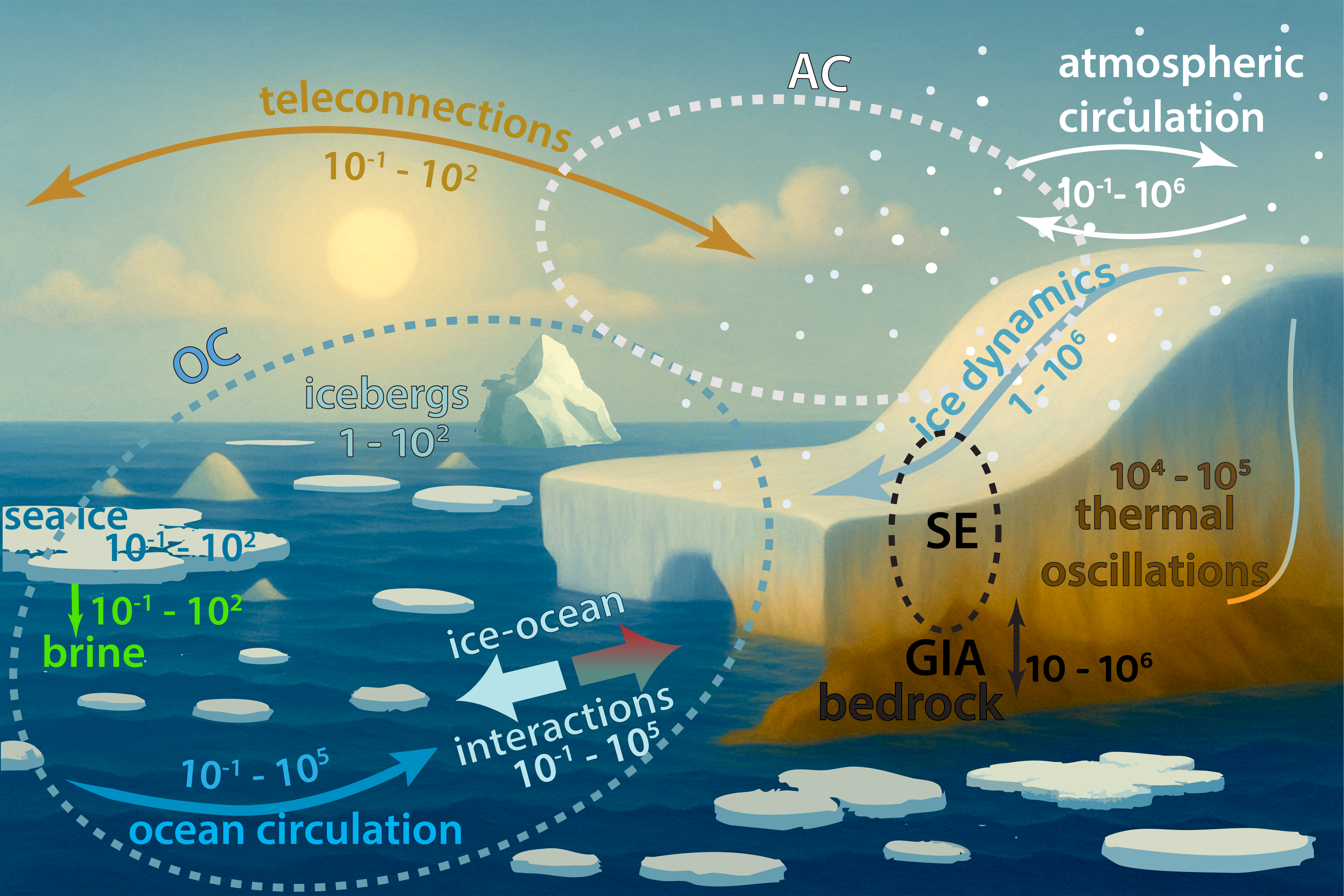
Ice sheets, the ocean and atmosphere are dynamical systems with internal variability that have strong interactions and feedbacks and a broad range of the characteristic timescales (indicated in years). Feedback loops are indicated by dashed lines. OC, the ocean–cryosphere feedbacks; AC, the atmosphere–ocean feedbacks; SE, the feedbacks between solid Earth and ice sheets. GIA, glacial isostatic adjustment.